


NVIDIA’s shares fell another 14% to $125.53 on Friday. $ANT, which had started trading on Nasdaq the day before, fell 8.5% to $88.91. Days like that show what investors fear about a company. They don’t show whether the company can keep up with its debt, its leases, and its purchase contracts if AI revenue grows more slowly than its plans assume.
Each of the companies building out AI infrastructure reports the figures that answer that question every quarter. Its 10-Q shows how much it has borrowed and how much interest it pays. The disclosures in its 10-Q also show the data center leases it has signed that haven’t started yet and the supply contracts it can’t cancel. Its revenue disclosures show how much it depends on one or two customers.
We pulled those figures for 12 companies tied to the AI buildout: NVIDIA, AMD, Broadcom, Micron, Microsoft, Alphabet, Amazon, Meta, Oracle, CoreWeave, Nebius, and Applied Digital. We then built a Python scoring model that ranks each company on seven measures: debt, interest coverage, free cash flow, future commitments, customer concentration, receivables, and S&P rating.
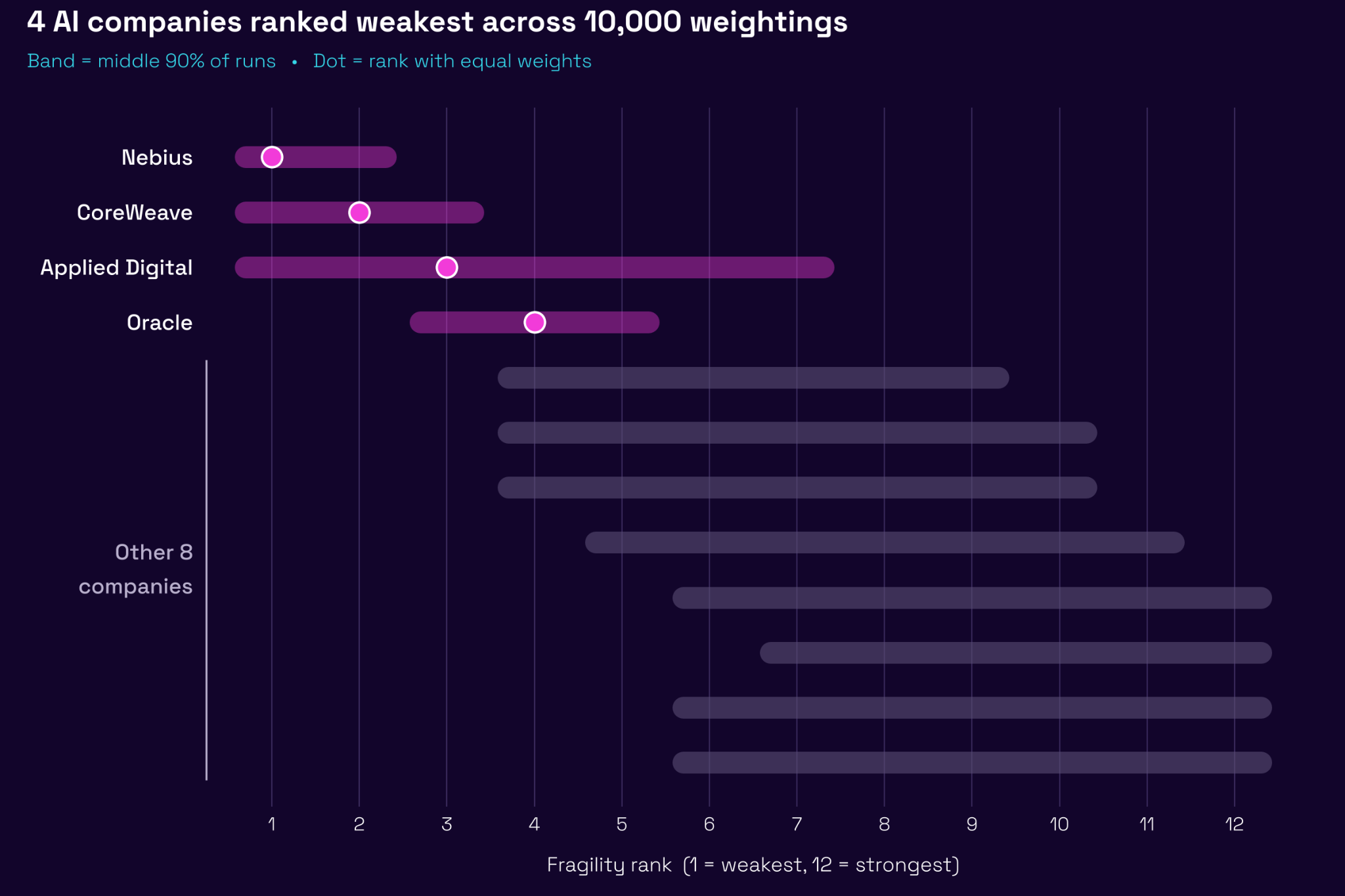
A ranking like this can change depending on how much weight each measure gets, so we tested ours. We reran the model with 10,000 random sets of weights and counted how often each company ranked among the four weakest.
Nebius and CoreWeave ranked among the four weakest in all 10,000 runs. Applied Digital did in 88% of them, and Oracle did in 87%. Broadcom came next at 13%, so no other company came close to those four. Oracle is the only one of the four with an investment-grade rating.
Five of the 12 companies carry an S&P rating of AA- or higher. One of them has signed leases and purchase commitments worth 3.35x its revenue over the last 12 months. That ratio is closer to Oracle’s 4.49x than to Microsoft’s 1.71x. S&P revised that company’s outlook to negative on October 30. Paid subscribers get its name, the full ranking with every input traced to a filing, and the spreadsheet so they can reweight the model and rerun it themselves.