


Production AI agents encounter four critical failure modes: unpredictable costs that spiral out of control without warning, debugging nightmares where problems leave no trail, brittleness that turns minor errors into total breakdowns, and integration complexity that multiplies risk across every external API. These obstacles turn promising prototypes into operational liabilities.
Teams need an engineered response: a starter kit that embeds solutions for cost control, observability, and resilience directly into an agent’s architectural foundation. The power of this approach lies in deliberate structure and explicit data flow. By organizing an agent system around interconnected design patterns, each addressing a specific failure mode, we transform debugging from archeology to engineering.
The AI Agent Starter Kit creates an agent architecture where every decision, action, and resource consumption leaves a structured, queryable trace. When something goes wrong, and it will, the system provides the precise diagnostic data needed to identify root causes and implement fixes.
Design Patterns for Agent Resilience
Four foundational principles guide this architecture, each targeting a specific production failure mode.
Cost-Awareness by Default: Every interaction with a language model must emit structured cost data before execution proceeds. This principle addresses the cost spiral problem by making resource consumption a first-class concern, tracked and logged at the same level as functional outputs. The architecture treats cost as an intrinsic state, never an afterthought.
Observability-First Design: The system records detailed, machine-readable logs for every decision, API call, and action the agent takes. This requirement applies to every component without exception. This counters the debugging nightmare by ensuring diagnostic data is available before problems occur. Observability becomes part of the contract each component must fulfill.
Explicit State Management: All task context, execution history, and intermediate results reside in a single, inspectable state object that flows through the system. This addresses brittleness by eliminating implicit assumptions and hidden dependencies. When the agent fails, its complete context remains available for analysis.
Defensive Tooling Patterns: Every external integration point includes automatic input validation, output verification, and error logging before results reach the agent’s reasoning layer. This mitigates integration complexity by standardizing how the agent interacts with external systems and ensuring failures at API boundaries generate diagnostic data rather than cascading into the agent’s logic.
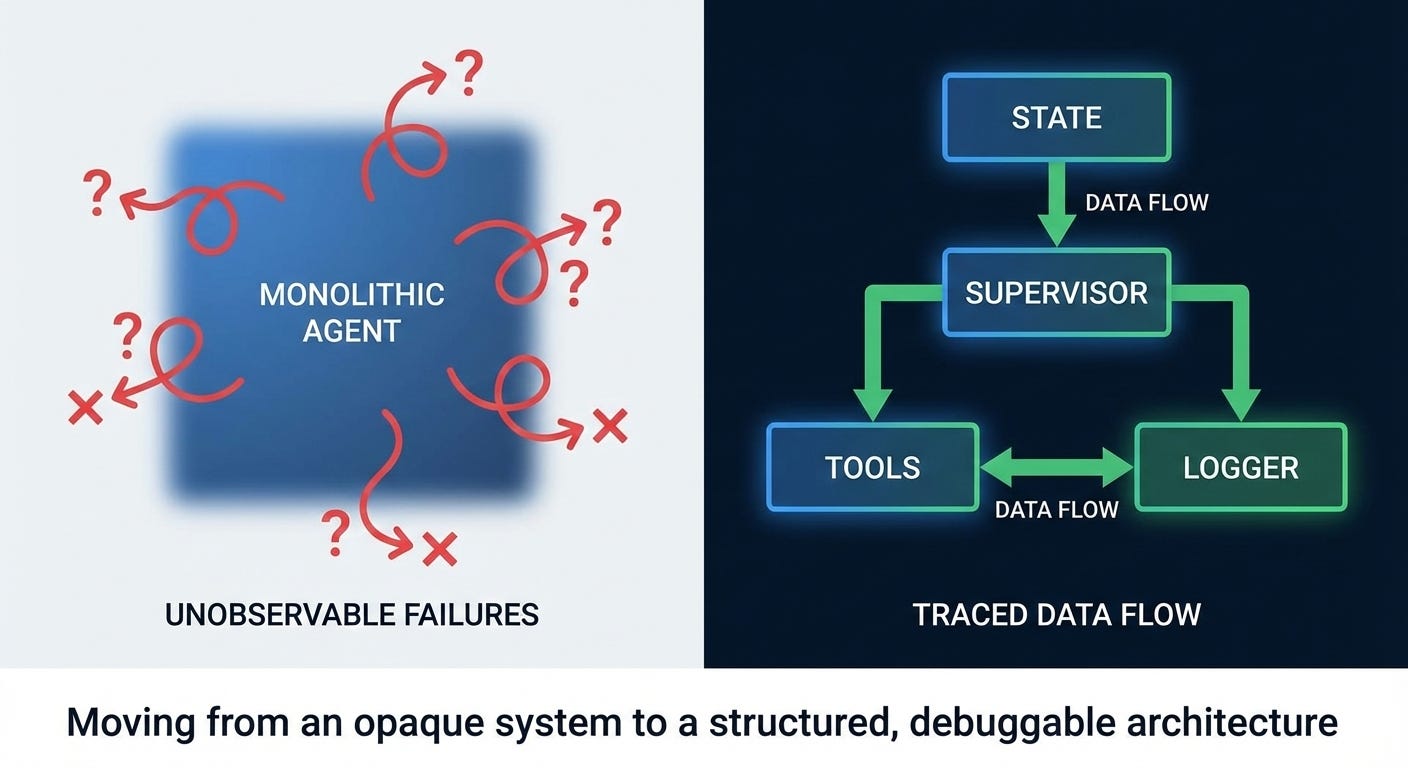
These four principles shape every component in the system. Understanding how they translate into concrete architectural patterns requires examining each layer in detail.