


Earlier this week, I walked through the working definition of an AI agent. A loop of three parts (Plan, Act, Observe) plus two supporting systems: memory and tools. Five parts in total. If a tool your company is using is missing one or more of them, it isn’t an agent, even if the person selling it to you is describing it as one.
Today’s build turns that definition into a working system you can copy.
A multi-agent system is an AI setup where one agent coordinates the work of two or more other agents to finish a job. The coordinating agent is called the parent. The agents it coordinates are called subagents. The parent decides which subagent handles each part of the job, reads each subagent’s output, and either combines the finished outputs into a final result or sends a subagent back with a narrower request if the output isn’t specific enough.
The reason to use a multi-agent system instead of one large agent is that each subagent gets to focus on a single task with its own instructions. That focus produces better output than asking one agent to keep every task in its memory at once. It also means the parent can send two subagents off to work at the same time, which gets the job done faster than doing every step in sequence.
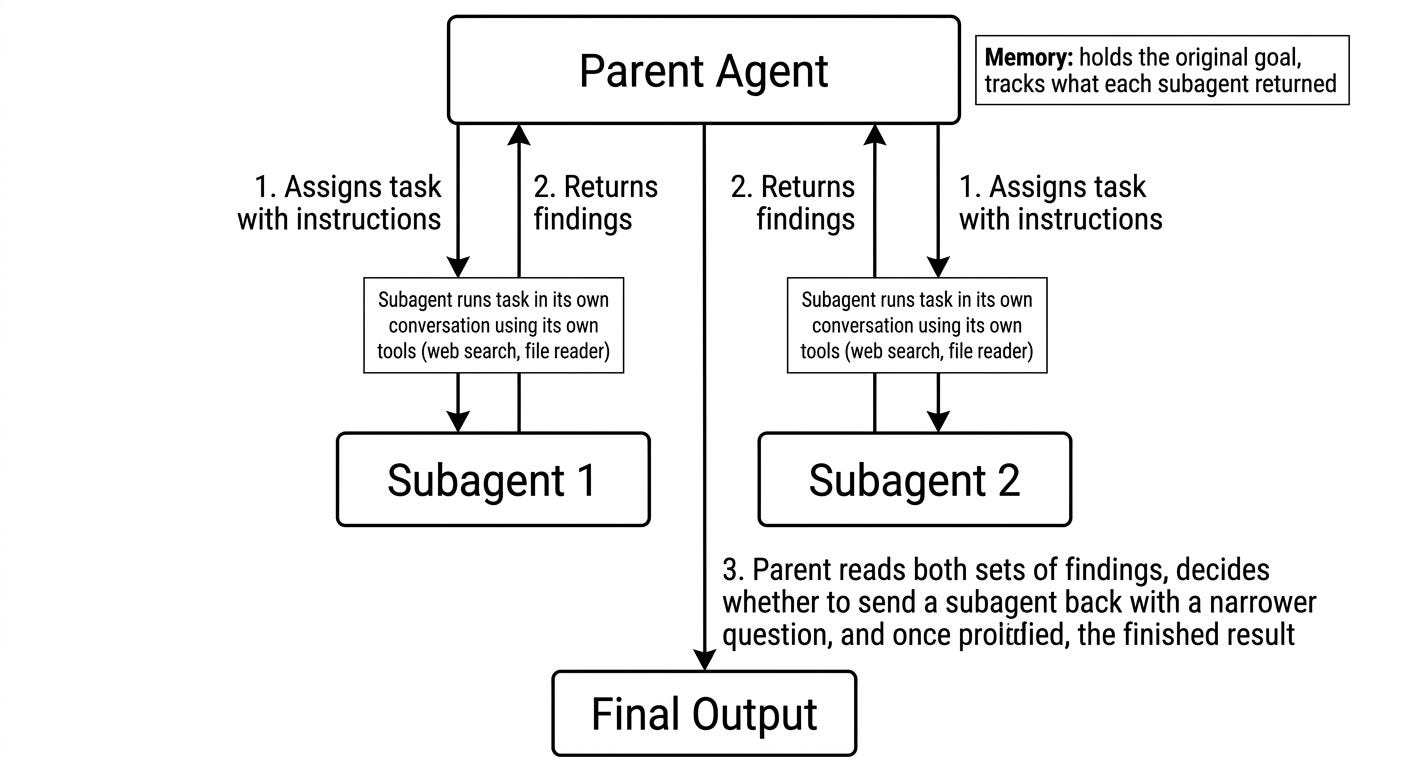
The build below turns this diagram into a working system on your machine.
What it includes: the three files you can copy directly into your own setup, a step-by-step walkthrough of a live run with every part of the system labeled inside the transcript, the follow-up request that shows the parent agent adjusting its next step based on what came back, and a set of concrete swaps for adapting this pattern to other recurring jobs your team runs every week.
👋🏿 Hey, I’m Hodman. I write The Data Letter for senior managers, operators, and technical builders rolling out AI. Here are some recent popular articles you may have missed:
➡ An n8n agent that reads your live metrics and reports them every Monday morning, grounded in a real spreadsheet so it stops inventing numbers.
➡ A four-artifact workflow for calculating AI ROI in a format your CFO will approve, built in 90 minutes.
➡ The intake form, screening guide, vendor checklist, and documentation workflow every enterprise AI project now runs through under U.S. state AI regulations.
In a few minutes, you’ll have a working multi-agent system running. Let’s build it.