


Everyone’s racing the wrong race.
Whose model scores highest? Whose benchmark beat whose? Who topped the leaderboard this week?
Model. Model. Model.
But inside your company, model IQ isn’t the thing hurting you.
Your agents pile up. Forget what they were doing. Snap the second one step downstream fails.
I keep seeing the same fear surface, even in seasoned teams: ‘We shipped the agent, so why does it keep breaking??’ Because building one and running one are two different jobs.
To be clear, I’m not anti-agent. I build them. I run them.
The trouble starts when everyone treats the model as the finish line and forgets the pipes underneath.
Here are some recent TDL articles on AI agents and orchestration you may have missed:
On the orchestration layer, and why it decides who gets leverage from cheap models: 'NVIDIA and AI Inference Economics in 2026.'
On building your own agent instead of waiting for a vendor: 'Build Your Own AI Agent Before Google Ships You Theirs.'
On the step-by-step build: 'n8n. local.' A private AI agent running on your own laptop in about 30 minutes, using n8n, Ollama, and Docker.
On grounding, the thing that keeps an agent from making things up: 'Build a RAG System with NotebookLM in Under an Hour.'
On reading a model honestly before you trust it: 'Build Your First AI Data Pipeline in Python.'
Why Reliability Beats Model IQ
So the contest is about reliability now.
When every vendor ships a frontier-class model, the model stops being worth fighting over. So the fight climbs one floor up. To the layer that decides which agent touches which system, gives each one an identity, logs what it did, and shuts it down when it misbehaves.
This is the control plane. The plumbing for a building full of agents.
Microsoft and Google Build the Agent Control Plane
Watch the giants. They’ve stopped pretending it’s about the model.
Last November, Microsoft shipped Agent 365 and named it ‘the control plane for AI agents.’ Registry, identity, security, the works. A place to govern every agent, whoever built it.
Then, in April 2026, Google launched the Gemini Enterprise Agent Platform. Build, scale, govern, optimize. Agent Identity. Agent Registry. An Agent Gateway they call ‘air traffic control for your agent ecosystem.’
Read the two feature lists side by side.
Registry. Identity. Governance. Gateway.
Two rivals, working apart, are using the same vocabulary to describe their products.
When competitors employ identical marketing language, they’re telling you where they think the market is headed.
And the prize they’re naming is the plumbing.
Accenture argued that Agentic AI is becoming the interface across your platforms, orchestrating work in real time. The agent sits on top of finance, the CRM, and the supply chain, and runs across them.
Whoever owns that orchestration layer owns the customer.
Reliability Problem Behind AI Agents
The first wave of agents is breaking in the field.
VentureBeat reported last month that teams are entering what one engineering leader calls a rebuild era. They rushed agents out, skipped the underlying plumbing, watched them crash, and went back to rebuild on a solid base.
Her words: ‘They had to move really fast, but they didn’t take care of the plumbing. Things crash and burn.’
Crash and burn.
Independent benchmarks back her up. Researchers found that for long-running tasks, the same agent can produce different results on each run. It finishes the job cleanly one day and falls apart the next.
In one benchmark, agents ran a small vending-machine business over many days. Some lost track of the job entirely and began sending angry, irrational emails to suppliers over a one-dollar fee.
So buyers care less about which model is smartest. They want to know one thing: Can I trust this to run, recover when it fails, and tell me what it did?
What Agent Platform Wars Mean for Your Team
Maybe you govern ten thousand agents. Maybe you run three workflows that your team relies on every morning.
Same problem at either size. No orchestration. Context that drops halfway through. No way to recover when one step fails. Same lesson, your scale.
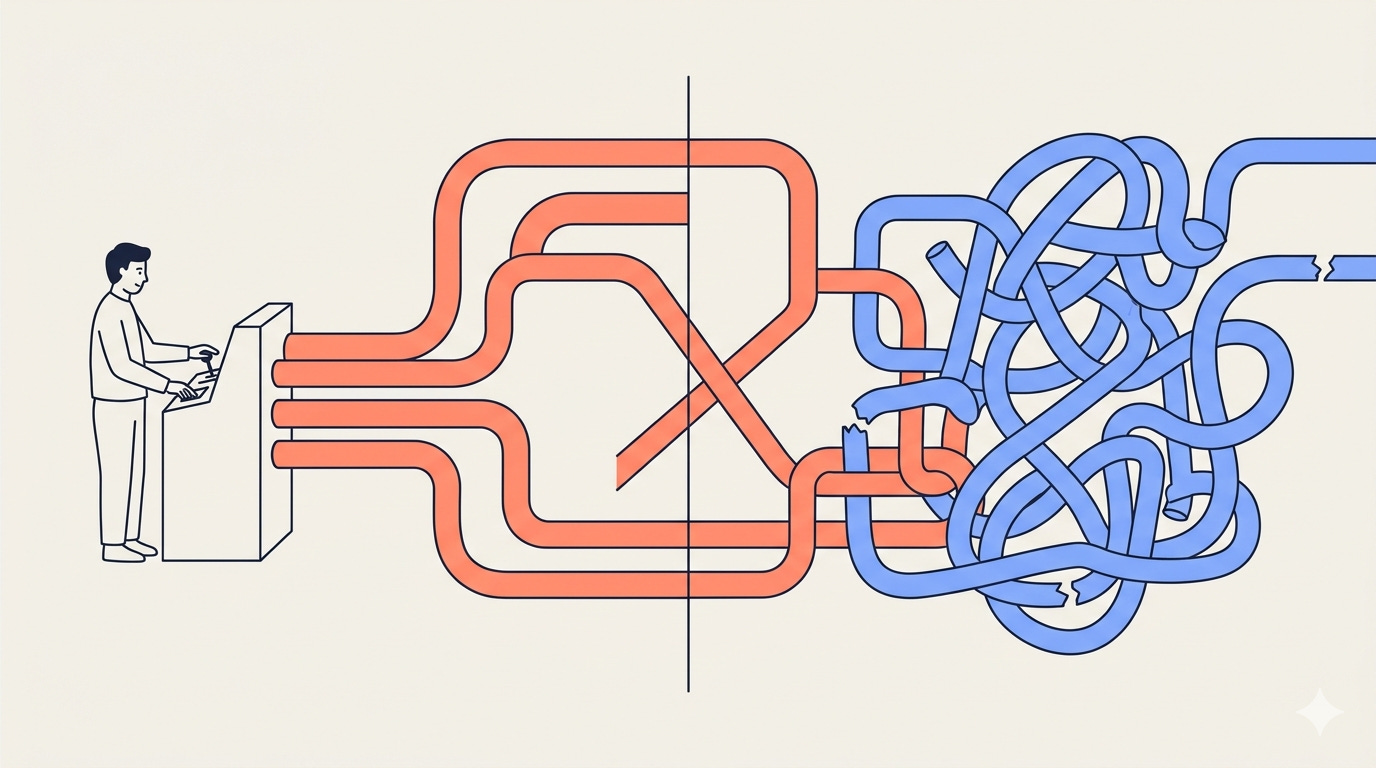
The takeaway: reliability comes from how you build, not how much you spend. The giants pay billions for it. You can build the same habits into one workflow on your own. Do that, and it keeps running when a step fails instead of crashing.
Ok, in closing.
The giants are spending billions to own their plumbing.
You can fix yours this week.
This Wednesday, June 3rd, 8:30 AM EST, I’m going live on Substack again: ‘Why AI Workflows Break (and How to Fix Yours Before It Costs You).‘ We’ll pull apart why these systems fail and what a steady one looks like.
You can read the follow-up to I Built an AI Agent That Sends Me My Numbers Every Monday Morning,’ is the system that fixes it, and it is walked through so you leave with one running.
A smarter model won’t save a workflow that keeps breaking. Build the system that keeps it running.