


Hut 8 builds power and data center infrastructure for computing companies. Galaxy Digital runs a digital asset business that offers trading and asset management. It also develops AI data centers on its Helios campus in Texas. This year, each company borrowed more than $3 billion in the bond market to build a new AI data center.
Hut 8’s subsidiary sold $3.25 billion of bonds due in 2042 at 6.192%. Galaxy’s subsidiary sold $3.5 billion of bonds due in 2031 at 9.875%. Hut 8 borrowed for more than three times as long and still paid about 3.7 points less.
The clearest difference between the two deals is whose credit backs the lease payments.
Google Backs the Lease on Hut 8’s Louisiana Data Center
Hut 8 signed a 15-year lease with Fluidstack, a company that builds and operates computing infrastructure for AI, for 245 megawatts of capacity at its River Bend campus in Louisiana. Google provides a financial backstop that covers Fluidstack’s lease payments. If Fluidstack misses a payment, Google makes it. For bondholders, that means every payment during the 15-year base term is backed by Google, whose parent company S&P rates AA+.
Hut 8 describes the notes as investment grade, even though the bonds are non-recourse to Hut 8. If the project fails, bondholders can claim the River Bend data center and its assets, but they can’t go after Hut 8 itself. Their protection comes from Google’s backstop on the lease payments. Hut 8 will also pay the bonds down in full by 2042, so no large balance comes due at maturity.

Galaxy’s Texas Data Center Depends on a CoreWeave Lease
Galaxy’s bonds have neither of those protections. They fund two buildings in Texas leased to CoreWeave. CoreWeave rents AI computing power to other companies. Three customers paid 72% of its revenue last quarter.
Galaxy’s parent company has guaranteed completion of the project, with no cap on what it could cost. Galaxy hasn’t disclosed any backstop on CoreWeave’s lease payments. Galaxy also pays its bonds down slowly. Principal amortizes at 4% a year once construction ends, so the bulk of the $3.5 billion comes due in 2031.

Treasury Yields Explain Part of the Difference
Some of the 3.7 points have nothing to do with tenants. The 10-year Treasury yield rose between April and July. Measured as a spread over the 10-year Treasury yield on each bond’s pricing day, Galaxy still paid about 330 basis points more than Hut 8.
Two other data center bonds sold this year paid spreads higher than Hut 8’s and lower than Galaxy’s. Applied Digital builds AI data centers in North Dakota and leases its Harwood campus to Oracle. CleanSpark is a bitcoin miner that has leased a new Georgia campus to a global technology company it hasn’t identified.
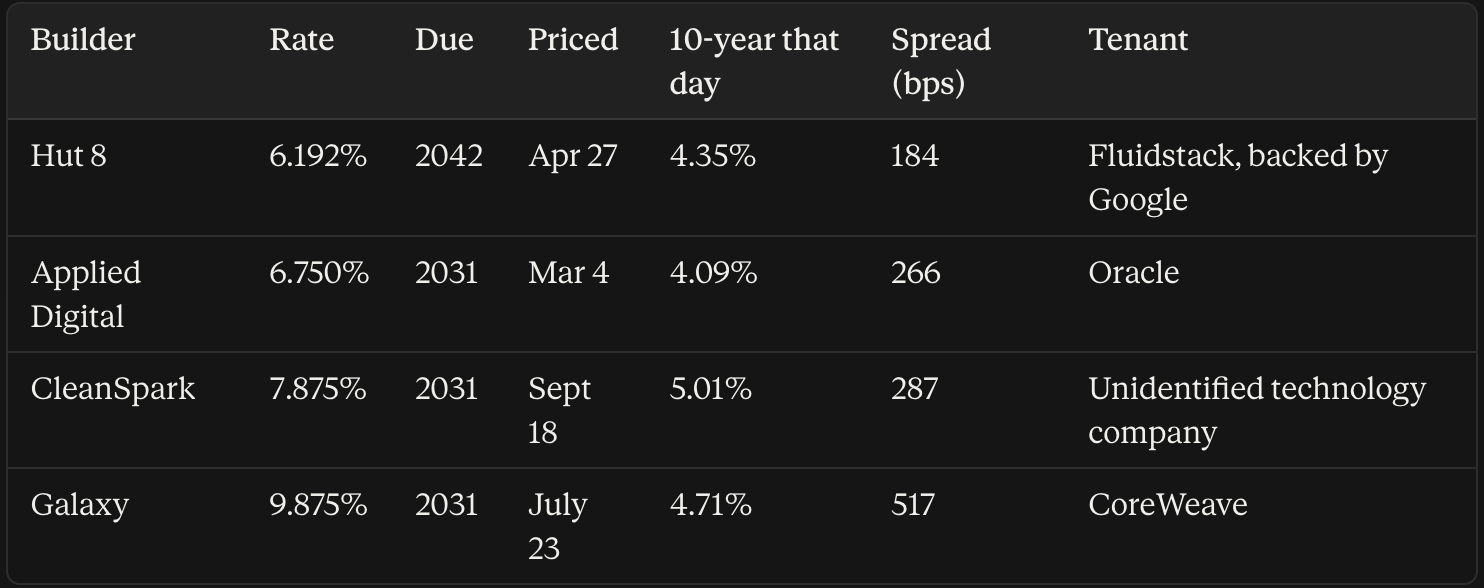
Applied Digital, CleanSpark and Galaxy sold their bonds below face value, so buyers earn slightly more than the rates shown. Hut 8 sold its bonds at full face value.
One Builder Borrowed Twice With the Same Tenant
Applied Digital’s rate changed sharply between two bond sales with the same tenant. It borrowed twice to build its Polaris Forge 1 campus in North Dakota, which it leases to CoreWeave:
In November 2025, it sold $2.35 billion of bonds at 9.25% when the 10-year Treasury yield was 4.11%. That put its spread at 514 basis points.
In June 2026, it sold $1.59 billion of bonds at 7.000% when the 10-year Treasury yield was 4.53%. That put its spread at 247 basis points.
Treasury yields rose between the two sales. Applied Digital’s spread still fell by more than half. Applied Digital doesn’t say why lenders charged less the second time. By the second sale, its first 100-megawatt building at the campus had been operational for 8 months.
Five weeks after Applied Digital’s 7% sale, Galaxy’s spread came in 270 basis points higher, even though both bonds depend on CoreWeave’s lease payments. A creditworthy tenant lowers what a builder pays to borrow, but the tenant alone doesn’t set the rate.
Find the Lease Backstop Before You Judge the Bond
Hut 8’s bond filing mentions a ‘guarantee related to the Data Center Project’ but doesn’t say who provides it. Hut 8 disclosed that Google provides the backstop four months earlier, in the press release announcing the Fluidstack lease. When you look at the next data center bond, read the builder’s lease announcement along with the bond filing, because the backstop may only be disclosed there.
Paid subscribers get the full audits behind pieces like this one, with every figure traced to its filing.
Which data center financing deal should I audit next?
Thanks for reading!