


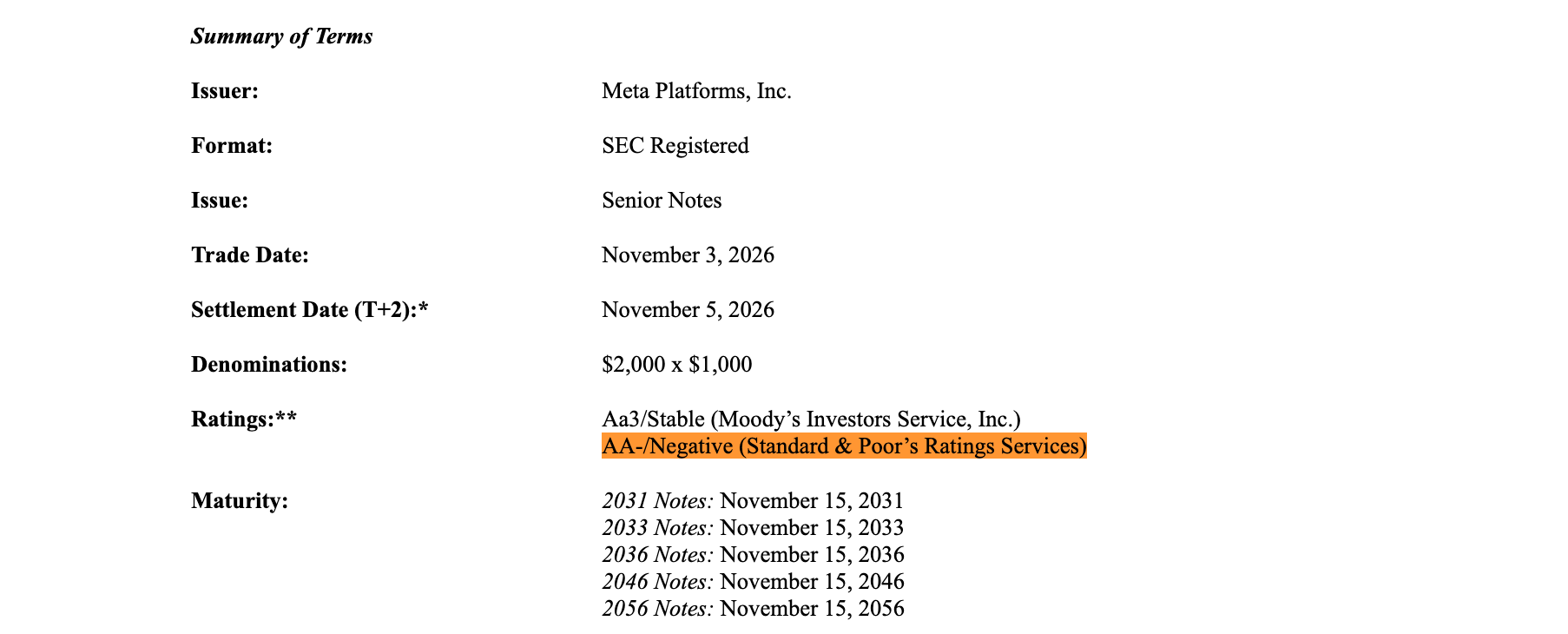
Meta sold $15 billion of new bonds on November 3. Its pricing term sheet lists Meta’s S&P rating as AA-/Negative. A day earlier, S&P gave that same negative outlook to $27.3 billion of data center bonds Meta didn’t issue.
Why Meta’s Rating Decides Hyperion’s Bond Rating
Blue Owl Capital set up Beignet Investor LLC to fund its 80% stake in Hyperion, Meta’s data center campus in Louisiana. Beignet sold $27.3 billion of bonds due May 2049. On November 2, S&P affirmed its A+ rating and revised the outlook to negative. Three days earlier, S&P gave Meta a negative outlook over uncertainty about its capex.
Meta guarantees construction cost overruns and the campus lease payments. It must start those payments on June 1, 2029, even if construction isn’t finished. Until construction ends, S&P rates Beignet one step below Meta. Any Meta downgrade lowers Beignet’s rating by the same amount.
An investor with both bond issues has one credit exposure through two issuers. A single Meta downgrade would reprice both.
Here are some recent popular articles you may have missed:
Why S&P Counts Brookfield’s Naver Investment as Debt
Naver, the Korean internet search company, plans to start selling AI data center capacity to customers in 2027. S&P expects it to have 200 megawatts running by the end of 2028. Brookfield Asset Management, the alternative asset manager, will put $9 billion into a Naver-controlled company that buys the GPUs.
Naver’s financial statements will record Brookfield’s $9 billion as equity in the form of a noncontrolling interest. S&P counts it as Naver’s debt instead. Brookfield’s returns come from payments that Naver’s cloud unit makes to the GPU company. Naver guarantees up to KRW18.7 trillion of those payments. S&P treats that guarantee like a lease Naver has to honor.
That changes how much debt Naver carries in S&P’s eyes. By S&P’s measure, Naver had no net debt in 2025 and 2026. S&P expects its adjusted debt to rise to KRW7.4 trillion by 2028 as Brookfield’s capital comes in. Over the same period, S&P expects adjusted debt to EBITDA to climb to 1.2x. It would consider a downgrade above 1.5x. Brookfield funds a new batch of GPUs only when Naver signs a customer for it. Each new customer contract adds to the debt S&P uses to rate Naver.
CoreWeave Reports Q3 2026 Earnings With Its Bonds Yielding 16%
CoreWeave reports its Q3 2026 results after the market closes today. It’s the company’s first earnings call since its bonds started trading at a 16% yield. In Deutsche Bank’s data, CoreWeave’s five-year credit default swaps (CDS) rose above 1,289 basis points on November 5. CoreWeave agreed to pay 9.625% a year when it sold its bonds due in 2032. If it borrowed again at around 16%, its new debt would cost far more.
CoreWeave’s revenue depends on contracts from hyperscalers. If those companies cut back their spending, neoclouds like CoreWeave could get fewer or shorter contracts. The call is CoreWeave’s chance to tell bondholders how it plans to fund its next round of data centers and how long its hyperscaler contracts run.
If you have capital exposed to AI debt, a paid subscription gives you:
The AI Financing Exposure Tracker, which shows who funds, guarantees, and owes on 38 AI financing deals. I trace every deal to its filing and update the tracker each month and after every earnings season.
A weekly audit of the obligations and guarantees behind one deal, taken from its 10-K, bond filings, and earnings calls.
Deep dives into credit spreads and yields.