Stress Test: $CRWV
Part 2 of our fragility model puts CoreWeave’s $47.5 billion of debt through a refinancing stress test

Bloomberg reported that two of CoreWeave’s bond issues hit record lows on Tuesday. At their lowest point that day, one traded at 74.9 cents on the dollar and the other traded at 76.6 cents. Prices like these show that investors are worried about CoreWeave’s debt. CoreWeave’s Q3 2026 10-Q shows which part of that debt matures first and what it would cost CoreWeave to borrow that money again.
CoreWeave borrowed at two very different rates this year. This past April, it sold $2.75 billion of bonds that pay 9.75% a year. That same month, it also sold $4.0 billion of convertible notes that pay 1.75% a year. Investors accepted the lower rate because each $1,000 note can be swapped for 8.3612 CoreWeave shares. That works out to about $119.60 a share.
Over the last 12 months, CoreWeave paid $2.41 billion of interest on $46.9 billion of debt. For a company that S&P rates B+, an average rate of about 5.1% is low.
In Part 1 of this series, we ranked 12 AI companies on seven measures from their filings, including debt to EBITDA, interest coverage, and commitments to revenue. We reran that ranking 10,000 times with different weights on the seven measures. CoreWeave ranked among the four weakest companies in every run.
CoreWeave’s GPU Loans Cost 9.5% While Its Convertible Notes Cost 2% to 3%
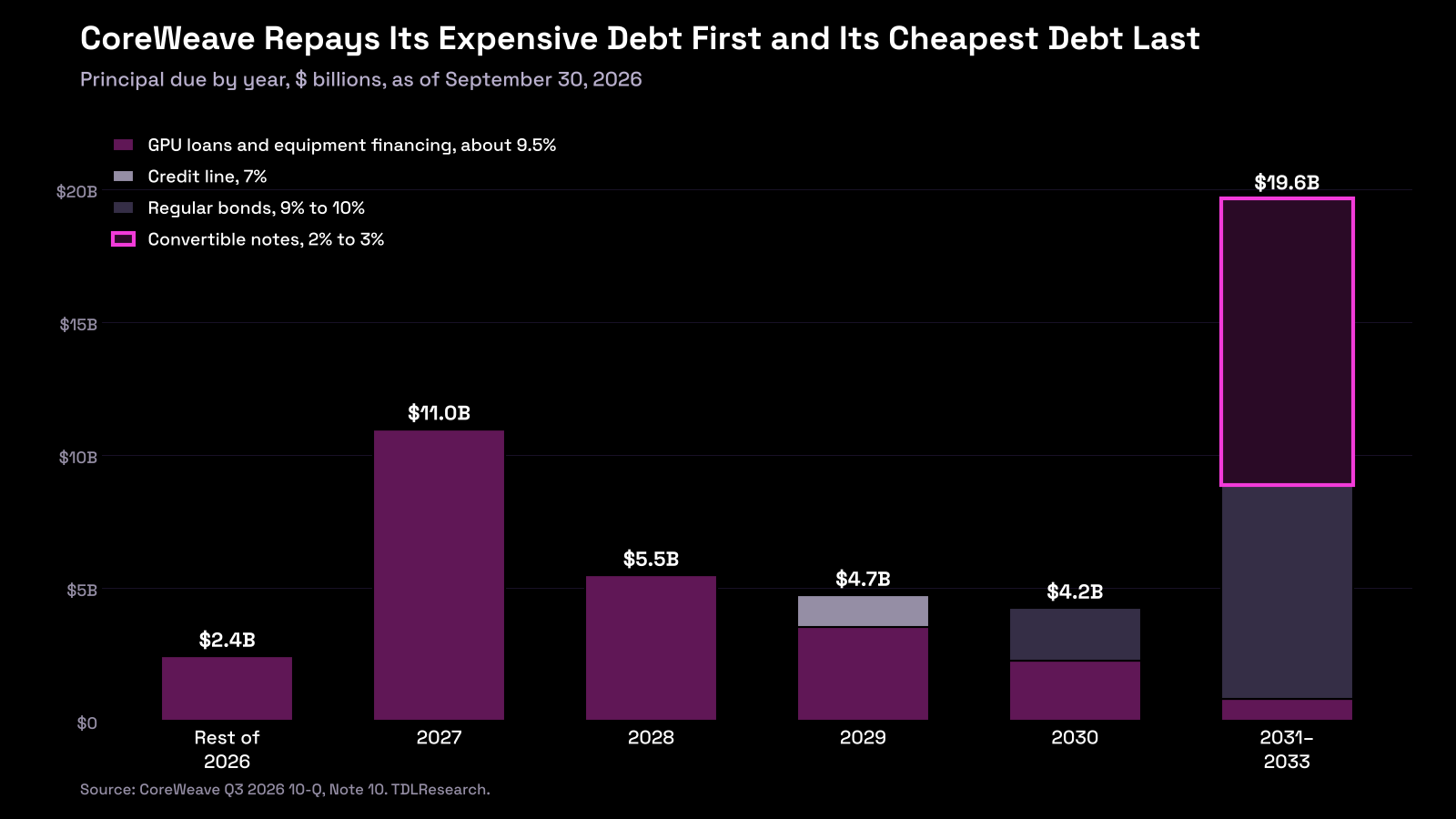
CoreWeave’s 10-Q lists each loan in Note 10, along with its maturity date and the interest rate CoreWeave pays. CoreWeave owes $25.5 billion on term loans and equipment financing that fund its GPU servers. Their rates range from 7% to 15% a year. Across all of them, CoreWeave pays an average of 9.54%.
CoreWeave also owes $10.0 billion on regular bonds at 9% to 10% a year and $1.2 billion on a credit line at 7%. Its $10.8 billion of convertible notes cost only 2% to 3% a year. Those notes bring the average rate on all of CoreWeave’s debt down to about 5%.
To see how long CoreWeave’s low average rate can last, we asked two questions:
If CoreWeave refinances the debt maturing through 2028 at the 9.75% it paid in April, how much does its interest bill change?
If CoreWeave’s stock trades below the conversion prices when the convertible notes mature, what does refinancing them in cash do to its interest coverage?
CoreWeave’s Debt Maturing Through 2028 Already Pays Close to Today’s Rates
CoreWeave has to repay $18.9 billion of principal between now and the end of 2028, according to the 10-Q. All of that money is owed on the term loans and equipment financing. CoreWeave’s bonds and convertible notes don’t mature until 2030 or later. Its credit line runs until November 2029.
We repriced the $18.9 billion at the 9.75% CoreWeave paid on its April bonds. CoreWeave’s interest bill rose by only $39 million a year because the loans being replaced already cost an average of 9.54%. On November 24, the 10-year Treasury yielded 4.91% and B-rated bonds paid 4.05% more than Treasuries. That puts the cost of borrowing for a B-rated company at about 8.96%. At that rate, CoreWeave’s interest bill would fall by $110 million a year.
CoreWeave’s Convertible Notes Mature in 2031, 2032 and 2033
CoreWeave’s $10.8 billion in convertible notes matures in December 2031, October 2032, and April 2033. CoreWeave’s 10-Q says the terms of the notes let CoreWeave repay them in cash, in shares, or in a mix of both. CoreWeave can pay the 2032 notes in shares and spend no cash if its stock trades above $119.60 at maturity. The same is true for the 2033 notes if its stock trades above $97.85. The 10-Q doesn’t give a conversion price for the $2.6 billion of 2031 notes, so we treat those as repaid in cash.
If CoreWeave’s stock trades below those prices, the notes are worth more as debt than as shares. CoreWeave would then have to repay the $10.8 billion in cash and borrow that money again at today’s rates.
How We Priced the Convertible Notes
We started with CoreWeave’s earnings and interest over the last 12 months, measured the same way as in Part 1.